


 Menu
Menu
- Fired brass cases
- New brass cases
- Pistol brass cases
- Rifle brass cases
- 22
- 25 Creedmoor
- 25 GT
- 243
- 260
- 284
- 30 Carbine
- 300 AAC Blackout
- 300 Norma Magnum
- 300 Remington Ultra Magnum
- 300 PRC
- 300 Win Mag
- 300 WSM
- 303 British
- 308
- 30-06
- 30-30 Winchester
- 33 XC
- 338 Lapua Magnum
- 338 Norma Magnum
- 408 Chey tac
- 45-70 Government
- 45-90
- 458 Socom
- 7mm PRC
- 7mm Remington Magnum
- 7mm-08 Remington
- 7x64
- 7x65R
- 7,35x51 Carcano
- 7,62x39
- 7,62x54R
- 7,65x53 Argentine
- 7,7x58 Japanese
- Revolver brass cases
- Bullets
- Accessories
- Optics
- Services
- New products
- Products on sale
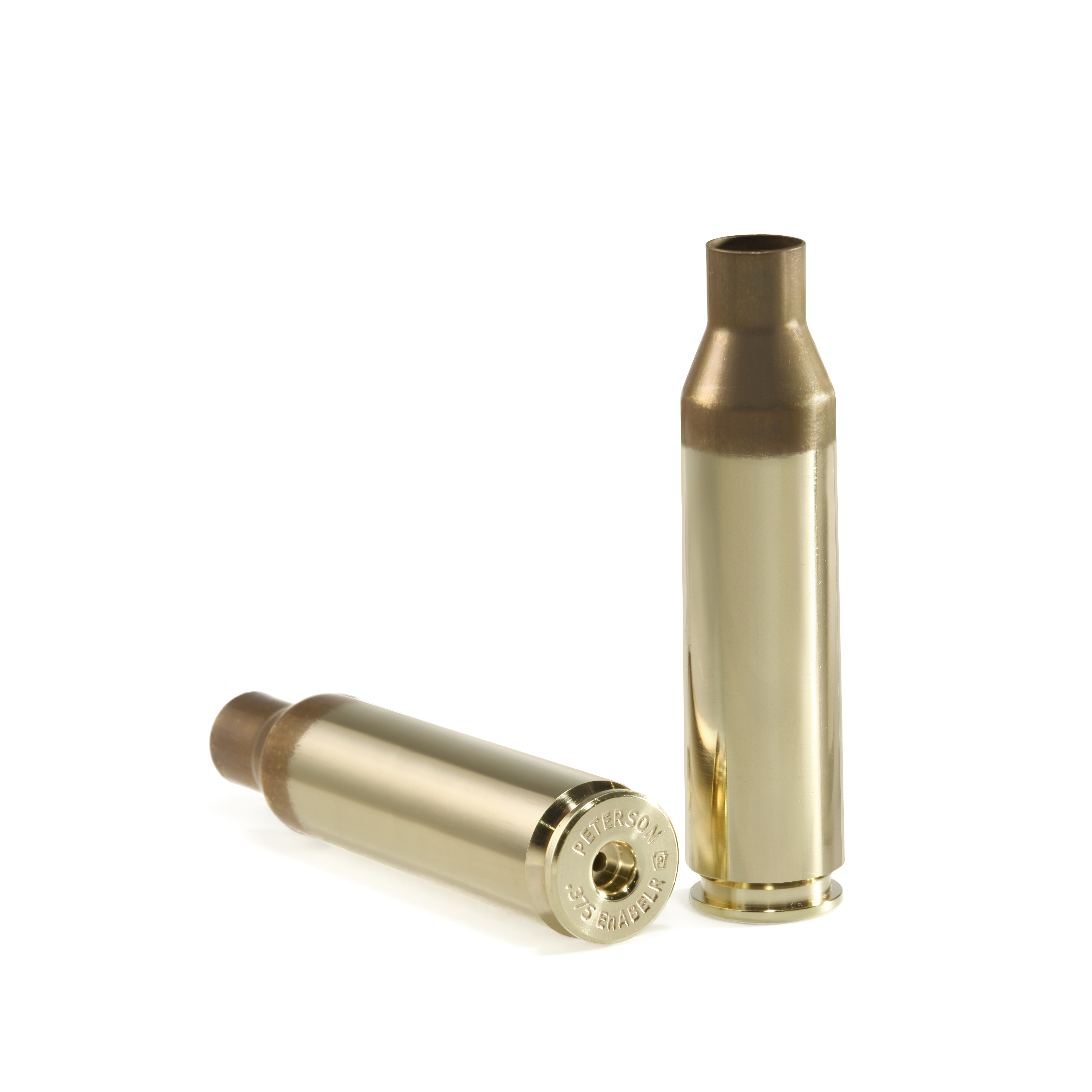
Brass cases Peterson .375 Enabler
Regular price:
Regular price:
product unavailable
add to wish list
0

Description
Peterson .375 EnABELR Brass – 50 Cases
Peterson .375 EnABELR is American-made Match-Grade brass developed for Extreme Long Range shooting. The cartridge was created through cooperation between Peterson Cartridge, Bryan Litz and Applied Ballistics. Its purpose was to deliver performance comparable to the .375 CheyTac in a shorter, wider cartridge capable of magazine feeding.
The correct name is .375 EnABELR, although the simplified spelling “.375 Enabler” is also commonly used in searches and product listings. EnABELR stands for “Engineered by Applied Ballistics for Extreme Long Range.”
Product specifications
- Calibre: .375 EnABELR
- Manufacturer: Peterson Cartridge Company
- Manufacturer’s code: 40022-R / 40022R
- UPC for the 50-case box: 810068270150
- Quantity: 50 cases
- Condition: new and unprimed
- Quality class: Match-Grade
- Case type: bottleneck with rebated rim
- Primer pocket: Large Rifle
- Nominal flash-hole diameter: 0.080 in / 2.03 mm
- Bullet calibre: .375 in
- Material: high-quality cartridge brass
- Factory-annealed neck and shoulder
- Country of manufacture: USA
- Application: ELR, long-range competition and precision rifles
Large Rifle Magnum primers are commonly used in cartridges of this capacity, but primer selection must follow current, verified load data. The physical primer-pocket size is Large Rifle.
Dimensions from the official Peterson drawing
The original Peterson drawing specifies dimensions in inches. The metric values below are rounded conversions.
| Parameter | Imperial | Metric |
|---|---|---|
| Maximum case length | 2.770 − 0.020 in | 70.36 − 0.51 mm |
| Maximum cartridge overall length | 4.625 in | 117.48 mm |
| Length to body/shoulder transition | 2.1409 in | 54.38 mm |
| Headspace dimension at 0.500-in datum | 2.3185 − 0.007 in | 58.89 − 0.18 mm |
| Length to shoulder/neck transition | 2.4357 in | 61.87 mm |
| Maximum rim diameter | 0.6398 − 0.010 in | 16.25 − 0.25 mm |
| Maximum rim thickness | 0.063 − 0.011 in | 1.60 − 0.28 mm |
| Extractor-groove diameter | 0.5433 − 0.020 in | 13.80 − 0.51 mm |
| Maximum body diameter near the case head | 0.6580 in | 16.71 mm |
| Reference shoulder diameter | 0.6360 in | 16.15 mm |
| Outside neck diameter | 0.4098 in | 10.41 mm |
| Maximum bullet diameter | 0.3760 − 0.003 in | 9.55 − 0.08 mm |
| Shoulder angle | 21° per side | 42° included |
| Headspace datum diameter | 0.500 in | 12.70 mm |
Unless a separate tolerance is shown, the drawing specifies a general diameter tolerance of −0.008 in. Peterson notes that the drawing is subject to change.
The .375 EnABELR is not currently covered by a public SAAMI or C.I.P. standard. Pressure limits for the .375 CheyTac or other similar cartridges must not be assigned to the .375 EnABELR.
Latest Peterson lot data
The latest .375 EnABELR lot currently published by Peterson is C174, inspected on 28 January 2025:
| Parameter | Published value |
| Lot number | C174 |
| Quality-control number | 122224 |
| Average empty-case weight | 367.4 gr / approximately 23.81 g |
| Average internal capacity | 155.4 gr H₂O / approximately 10.07 cm³ |
| Shoulder diameter | 0.632 in / 16.05 mm |
| Base diameter | 0.654 in / 16.61 mm |
| Neck-wall thickness | 0.0165 in / 0.419 mm |
| Outside neck diameter with seated bullet | 0.406 in / 10.31 mm |
| AMP Aztec annealing code | 0173 |
| AMP pilot | No. 88 |
| AMP machine | Mark II |
Comparison of recent production lots
| Lot | Inspection date | Case weight | H₂O capacity | Shoulder | Base | Neck wall | Loaded neck |
| C174 | 28 Jan 2025 | 367.4 gr | 155.4 gr | 0.632 in | 0.654 in | 0.0165 in | 0.406 in |
| C173 | 27 Jan 2025 | 370.5 gr | 155.4 gr | 0.633 in | 0.654 in | 0.0167 in | 0.407 in |
| C172 | 2 Dec 2024 | 365.4 gr | 156.1 gr | 0.633 in | 0.654 in | 0.0164 in | 0.406 in |
| C171 | 20 Nov 2024 | 366.8 gr | 155.7 gr | 0.632 in | 0.654 in | 0.0163 in | 0.407 in |
These measurements are reference values for individual production lots, not guaranteed dimensions for every box. When changing lots, internal capacity, shoulder position, neck thickness and die settings should be checked again.
Original Applied Ballistics design
The .375 EnABELR is not simply a modified version of an existing cartridge. According to Peterson, it has no parent case and was designed from the ground up. Peterson contributed to its internal construction, including case-wall and web thickness.
Compared with the .375 CheyTac, the EnABELR case is:
- shorter;
- wider;
- equipped with a rim smaller than the case body;
- designed for a shorter cartridge overall length;
- intended to allow magazine feeding with long ELR bullets;
- similar in internal capacity.
Recent Peterson .375 EnABELR lots have approximately 155–156 gr H₂O capacity, compared with approximately 159–160 gr H₂O for Peterson .375 CheyTac brass. The wider body therefore retains substantial capacity while allowing a noticeably shorter case.
Magazine feeding depends on the rifle, chamber, cartridge overall length and magazine design. It does not mean that the cartridge will feed from every magazine designed for the .375 CheyTac.
Main design advantages
The .375 EnABELR was developed to reduce problems associated with extremely overbore ELR cartridges, including heavy fouling, increasing velocity and pressure during extended shot strings and a very short period of stable barrel performance.
Applied Ballistics identifies the following advantages:
- ELR performance from a more balanced case capacity;
- compatibility with long, very-high-BC bullets;
- magazine-feeding capability in properly designed systems;
- reduced tendency for velocity migration during extended shooting;
- more predictable ballistic performance;
- lower cleaning requirements than larger extreme wildcats;
- no need to form cases from another calibre;
- availability of finished brass, dies and chamber reamers;
- good case life when operated within suitable pressure limits.
The cartridge was developed primarily around heavy, high-BC .375-calibre bullets, including the Berger 379 and 407 gr Solids and comparable ELR projectile designs.
Applied Ballistics testing
Before the cartridge was commercially released, Applied Ballistics conducted testing for most of a year using four competition rifles and four test rifles. Different barrel lengths, twist rates and projectiles were evaluated.
Early prototype Peterson cases were used at least eight times during load development. Applied Ballistics reported good durability, provided the cases had not been subjected to excessive pressure that permanently expanded the case head.
The testing team did not report unexplained velocity migration or unusual cartridge-related problems during its competition season. The .375 EnABELR was also used successfully in ELR competitions at distances exceeding two miles.
Testing and competition results demonstrate the potential of the design but do not guarantee a particular level of accuracy, velocity or number of reloads.
Benefits reported by shooters
Users of Peterson .375 EnABELR brass most frequently mention:
- a very strong case head;
- tight and consistent primer pockets;
- repeatable internal capacity;
- good durability through repeated reloadings;
- uniform neck dimensions;
- consistent factory annealing;
- no need to form brass from another cartridge;
- performance comparable to the .375 CheyTac in a shorter cartridge;
- suitability for magazine-fed ELR rifles;
- manufacturing quality appropriate for precision ammunition.
User reports describe cases remaining in good condition after five, eight or more firings. Actual case life depends on pressure, chamber dimensions, die adjustment, shoulder bump and annealing frequency.
Some users describe the primer pockets as exceptionally tight. A suitable priming tool should be used, and the pockets should not be modified without first taking accurate measurements.
Reloading-equipment compatibility
Specialist .375 EnABELR dies are available from manufacturers including Forster and Whidden. Because of the case size, some die sets use 1¼-12 press threads rather than the standard 7/8-14 thread.
Applied Ballistics specifies compatibility with a No. 47 shell holder. Shell-holder numbering may differ between equipment manufacturers.
Before purchasing or adjusting dies, check:
- compatibility with the current chamber drawing;
- case-body diameter after sizing;
- shoulder position after sizing;
- required neck-bushing diameter;
- the thread size of the reloading press;
- loaded-cartridge fit in the magazine.
Older user reports mention that some die versions did not sufficiently size the case body. This did not necessarily indicate defective brass, but could result from a mismatch between the die, chamber and dimensions of the specific brass lot.
Preparation before first use
- Inspect every case for shipping damage.
- Measure case length, base diameter and shoulder position.
- Verify headspace and proper chamber fit.
- Check neck clearance with the intended loaded-cartridge dimensions.
- Lightly chamfer or deburr the case mouth if required.
- Adjust the sizing die using chamber measurements and brass fired in the specific rifle.
- Use only verified load data developed specifically for the .375 EnABELR.
Because the cartridge is not standardized by SAAMI or C.I.P., .375 CheyTac data must not be used merely because the two cartridges have similar capacities and use bullets of the same calibre.
Safety
Shipping costs
The price does not include any possible payment costs
3 850,00 zł
Regular price:
3 970,00 zł
3 130,08 zł
Regular price:
3 227,64 zł
790,00 zł
Regular price:
820,00 zł
642,28 zł
Regular price:
666,67 zł
1 850,00 zł
Regular price:
1 990,00 zł
1 504,07 zł
Regular price:
1 617,89 zł